The Katakana vowel symbols are as follows: a = ア, e = エ, i = イ, o = オ, u = ウ. These symbols make up non-Japanese introduced words.
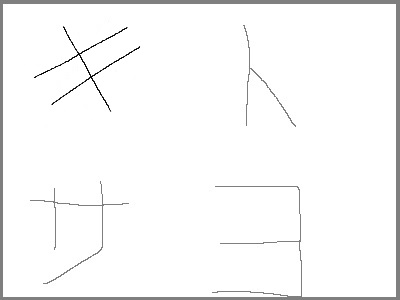
The word email in Katakana would be メール (mēru) and the name Simon would be サイモン (Saimon). Note, the line between the 'mēru' Katakana characters indicates a macron(ー). In the image below we have the sound 'Ki' (top left), then 'To' (top right), 'Sa' (bottom left), and finally 'Yo' in the bottom right.
The Hiragana vowel symbols are as follows: a = あ, e = え, i = い, o = お, u = う.
The 'a' sound is pronounced 'ah', the 'e' sound is pronounced 'eh', the 'i' sound is pronounced 'ee', 'o' is pronounced 'oh' and the 'u' sound is pronounced 'oou'. This sounds similar to the ending on the word 'you'. The sounds are the same for both Hiragana and Katakana.
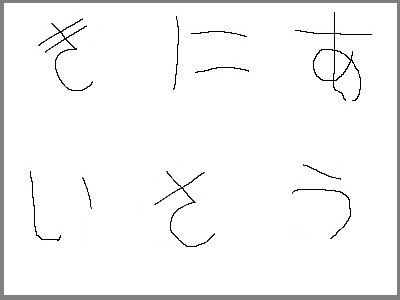
The image below is the traditional Japanese text, it reads as follows: 'Ki' (top left); 'Ni' (top middle); 'A' (top right); 'I' (bottom left); 'Sa' (bottom middle); and finally the letter 'U' (bottom right).
Some everyday examples of Japanese words in Hiragana are thank you - ありがとう ございます (arigatō gozaimasu), afternoon greeting/hello - こんにちわ (konnichiwa), just right - ちょうど いい (chōdo ii), it is raining - あめ です (ame desu), rice - ごはん (gohan), eggs - たまご (tamago), kuruma - くるま (car), bread - ぱん (pan), bag - かばん (kaban), bird watching - やちょう かんさつ (yachō kansatsu), mura - むら (village) and Tōkyō is - とうきょう.
Some items can be known by more than one word for example 'bag' can also be called 'fukuro' ふくろ. Some other words to note great - subarashii すばらしい, ball is bōru - ぼうる, train is densha - でんしゃ and ticket is kippu - きっぷ (you use small っ if the word has double letters) there is no single 'p' symbol.
If you were wondering why some Hiragana words have the addition of う this is basically just the same as the macron symbol ō, ā, ū, ē or ī in the Japanese language.
Some more Hiragana symbols are displayed below:
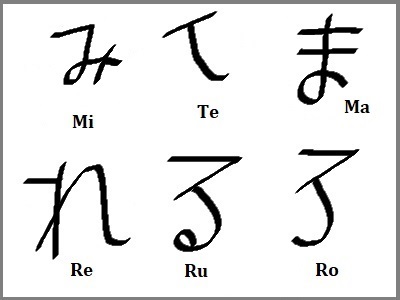
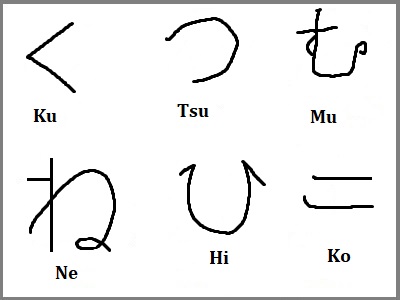
These symbols convey a meaning or main idea and Hiragana express the tense (present/past). It is fine to use only Hiragana but Kanji can be used for words as well as for numbers which is explained later in this section.
The image displayed below will be at random, try to remember the symbol then hover your mouse over to reveal its meaning. This should help you to practice and learn them. Also note that some of the kanji have Hiragana characters above them to help with pronounciation/identification. Press F5 or press the web browser refresh button to generate a different image. This is random so you may get the same image twice. Alternatively, just check back every now and then and there should be a new kanji.
My advice for learning Katakana, Hiragana & Kanji and what worked for me was to write them in a small notebook and I would practice them every now and then. Not every symbol is listed here this is just a selection.
If you are viewing this on a phone and can't see the hover info some of the verbs in Hiragana are - mimasu(look/watch) みます, ikimasu(go) いきます, yomimasu(read) よみます, kaimasu(buy) かいます, kikimasu(listen) ききます and hanashimasu(speak) はなします.
As for the writing or reading of the numbers you write them as you say them. So, 400 - 四百 (yonhyaku), 453 - 四百五十三 (yonhyaku gojūsan). Remember, if it is a price('nedan') it will have the yen('en') kanji like so 円 or this symbol ¥ with it. Also, a few of the numbers are said slightly differently for example, 8000 is 'hassen' but the symbols are the same - 八千. 600 is 'roppyaku' and 800 is 'happyaku'. As this is related this is a good time to teach you another verb - Kaimono shimasu (do shopping).
You can either grab a pen and paper or just use the text box below to write your answers. When you're happy with your answers press the button below to reveal the correct answers. If you go to accessories on your operating system and open the character map check the box for 'advanced view' then under 'character view' select Japanese all the symbols are listed there. Make sure you check you have the correct one some Hiragana and Katakana symbols are very similar.