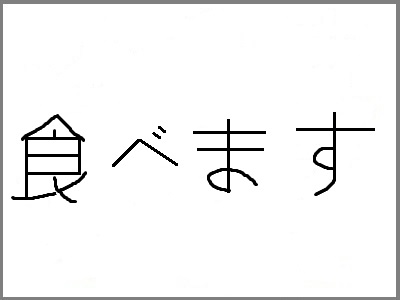
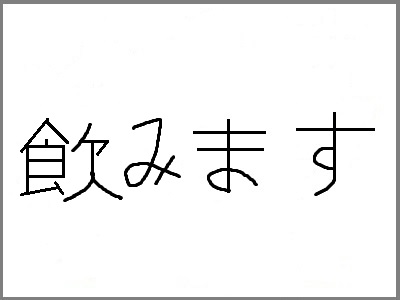
It's time to learn about a few more verbs in addition to the ones that you've already come across so far. Here are four new ones: tabemasu; nomimasu; okimasu and finally nemasu. If you've already worked out that verbs typically end in 'masu' then you would be correct. So what do these new verbs actually mean well in the Basics of Japanese section you briefly learnt about two of them. Tabemasu(たべます) and nomimasu(のみます). The first means to eat and the second means to drink. Okimasu(おきます) means wake up or get up and nemasu(ねます) means to sleep basically.
Two other verbs to note is shimasu(します) which means play, make or do and ikimasu(いきます) which means to go. If you used my random image generator previously you would have come across this verb before. Lets put together some examples using these verbs. Banana o tabemasu - I eat banana. Ringo o tabemasu - I eat apple. Gyūnyū o nomimasu - I drink milk. Sakkā o shimasu - I play soccer. You link the object you are interacting with using the particle 'o'.
Now for the other verbs. Shichiji ni okimasu - I get up at 7 o'clock. Jūji ni nemasu - I go to sleep at 10 o'clock. Sūpā ni ikimasu - I go to the supermarket. You link these words together using the particle 'ni'. If you can remember the directions section 'ni' was used there. This is known as a movement particle.
Here are 30 commonly used Japanese verbs and how to pronounce them from my channel:
Link to my YouTube VideoYou may be wondering well how do you say you don't eat or drink something. To do this you change the ending 'masu' to 'masen'. Biru o nomimasen - I don't drink beer, sakana o tabemasen - I don't eat fish. Tenisu o shimasen - I don't play tennis. Shigoto ni ikimasen - I didn't go to work.
To speak about something in the past tense you change the 'masu' ending to 'mashita'. Ringo o tabemashita - I ate an apple, Kōcha o nomimashita - I drank black tea. Mura ni ikimashita - I went to the village.
In the Basics of Japanese section you would have come across the particle 'wa' and the particle 'ga'. 'Wa' gives emphasis to what the subject of the sentence is and 'ga' means but. Think of 'ga' like a connector of sorts. 'Demo' is another word for 'but' just to make you aware. Be careful with using the Hiragana symbol for 'wa'. This symbol わ should be used if it is part of a word but this symbol は is used when it is used as a particle or by itself. 'Ka(か)' is another particle you are familar with, remember 'ga arimasu ka', this is the question mark symbol in Japanese effectively.
There is another important particle to take note of and that is 'no'. This is used to show possession or ownership in other words. Three other particles to take note of 'mo' which means also, 'de(で)' which means in or at and 'to' which means and, for or with. Below we have some examples using each of these particles:
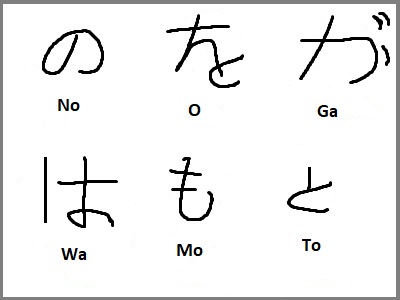
You have previously learnt how to say you want to eat or drink something, well now you might be asking how do you say you want to play, read or watch something. You drop the 'masu' ending from the verb and replace it with 'tai desu' like before.
Time for some examples then. If you want to watch a film you would say 'eiga o mitai desu'. To say you want to play a game you would say 'gēmu o shitai desu' and to say you want to read a book you would say 'hon o yomitai desu'.
If you want to invite someone to do something or to go somewhere you can do this with the use of 'ka'. As explained earlier 'ka' at the end of a sentence means a question is being posed. In conjunction with 'ka', you use the ending 'masen' to achieve this. So, you could say 'piza o tabemasen ka' (do you want to eat pizza?). Another example - toshokan ni ikimasen ka (do you want to go to the library?).
If you got most or all of the quiz questions right well done. Renshū shimasu means to practice in Japanese and that is my advice to you. I would write the symbols down in train stations and bus stops until I knew them all. Same for new words and phrases.